
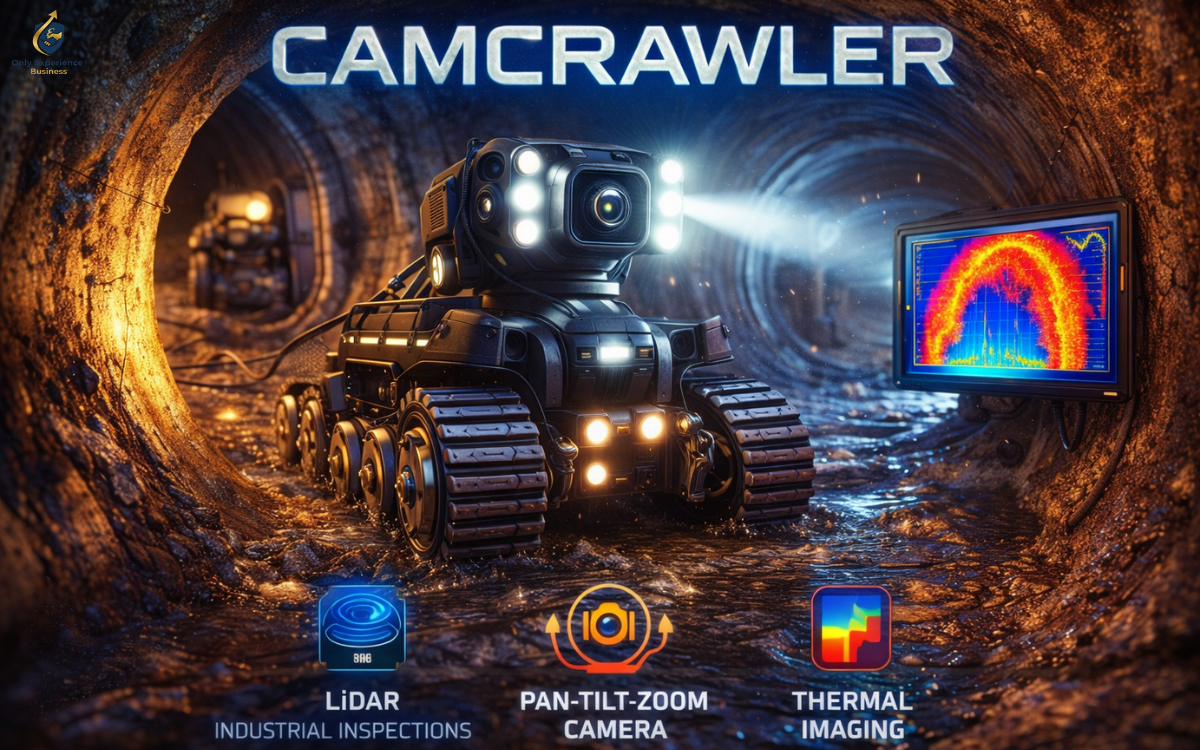
Within the evolving field of industrial automation, the CamCrawler has become an essential instrument for subterranean and confined-space exploration. Equipped with high-definition optical sensors and robust, multi-terrain mobility, these robotic systems are engineered to access environments that are otherwise inaccessible or hazardous to human operators. Applications range from municipal infrastructure management to complex industrial inspections, positioning the CamCrawler as a convergence of remote sensing and precision engineering. The development of these advanced machines integrates several core engineering disciplines: mechanical engineering supports the robust chassis and locomotion systems, electrical engineering manages power distribution and sensor integration, and software engineering enables advanced data processing and control algorithms. Collectively, these disciplines translate theoretical engineering concepts into practical solutions for real-world challenges.
Technical Architecture and Mobility
A CamCrawler is fundamentally a remotely operated vehicle (ROV) distinguished by its low-profile chassis and high-torque drivetrain. In contrast to standard drones, which are constrained by battery life and flight stability, crawlers are frequently tethered to provide a continuous power supply and a high-bandwidth data link for real-time video transmission. Tethering is generally preferred over wireless communication in these environments because it supports stable, high-quality video streams and ensures reliable control in areas with signal obstruction or interference. Although a tether may limit the crawler’s mobility and operational range, especially in complex or extended conduits, it eliminates downtime related to battery replacement and reduces the risk of lost connections underground. This engineering compromise prioritizes consistent data transmission and operational reliability over unrestricted maneuverability, making tethered systems the standard for most confined-space inspections.
The term “crawler” denotes its specialized locomotion system, which typically employs multi-wheel drive or continuous tracks. To navigate complex obstacles such as debris, mud, and uneven surfaces within pipelines, culverts, and storage tanks, CamCrawlers frequently incorporate articulated joints into their chassis. This design enables the robot to bend and maneuver around sharp corners or constricted pathways. Certain models utilize suspension systems that independently adjust each wheel, thereby maximizing traction and stability in variable or slippery terrain. Additionally, modern units are often modular, permitting technicians to exchange tires or tracks based on the diameter and material of the conduit under inspection.
This post offers an alternative explanation: https://onlyexperiencebusiness.com/wellstar-smart-square/
Optical Capabilities and Data Acquisition
The principal payload of a CamCrawler is its imaging system. Advanced models are equipped with Pan-Tilt-Zoom (PTZ) camera heads that provide 360-degree rotation and substantial magnification capabilities. These features enable inspectors to detect hairline fractures, corrosion, or blockages with high precision.
In addition to standard visible light cameras, many CamCrawlers are equipped with the following technologies:
- Lidar and Sonar: These sensors generate three-dimensional maps of internal structures.
- Thermal Imaging: This technology detects temperature anomalies that may indicate leaks or structural weaknesses.
- Laser Profiling: This method measures the ovality or deformation of pipes over time.
Primary Industrial Applications
CamCrawler technology is utilized across several critical sectors:
- Municipal Infrastructure: Municipalities deploy these robots for routine Sewer System Evaluation Surveys (SSES). Early identification of root intrusions or structural collapses enables targeted repairs, reducing the need for costly full-scale excavations.
- Oil and Gas: In the petrochemical sector, crawlers inspect long-range pipelines for internal corrosion and weld integrity, thereby supporting environmental safety and regulatory compliance.
- Search and Rescue (SAR): Following structural collapses, compact CamCrawlers are deployed into voids to search for survivors. These robots provide rescuers with visual data while minimizing the risk of further disturbance to unstable debris.
The Future: Autonomy and AI Integration
The next generation of CamCrawler technology is advancing toward full autonomy. While current models require skilled technicians for navigation, emerging AI-driven systems are capable of autonomously mapping pipe networks. These systems utilize machine learning algorithms, such as convolutional neural networks (CNNs) for image recognition and anomaly detection, to automatically identify defects. Researchers are also investigating reinforcement learning methods to optimize navigation through complex pathways. However, automating inspection in underground or confined environments presents significant challenges, including limited labeled data for training, dynamic and visually ambiguous conditions, and the necessity to differentiate between benign irregularities and genuine structural hazards. Addressing these challenges will further reduce human error and substantially increase the speed of data processing.
As global infrastructure continues to age, reliance on CamCrawler technology is expected to increase. By providing remote visual access in inaccessible environments, these machines help ensure the longevity and safety of the concealed systems that underpin modern civilization.
